



Phone scams made up 42% of the incidents reported to Romania’s National Cyber Security Directorate (DNSC) in the first half of 2026, followed by email phishing at 14% and SMS phishing at 13%. Together, these three forms of social engineering account for almost seven in ten reports, and each one succeeds by persuading a person.
CyberPlay trains that person in three moves. A short video lesson explains how and why an attack works, using real-world, up-to-date examples. Gamified cybersecurity scenarios then reveal how each employee would actually respond when faced with a threat. Every decision and interaction is analyzed and quantified through CyberSense – a measurable score that gives both employees and organizations a clear view of their cybersecurity strengths, behaviors, and potential gaps.
How does CyberPlay train employees?
CyberPlay trains employees through a loop of learning, practice and feedback that repeats for every everyday threat.
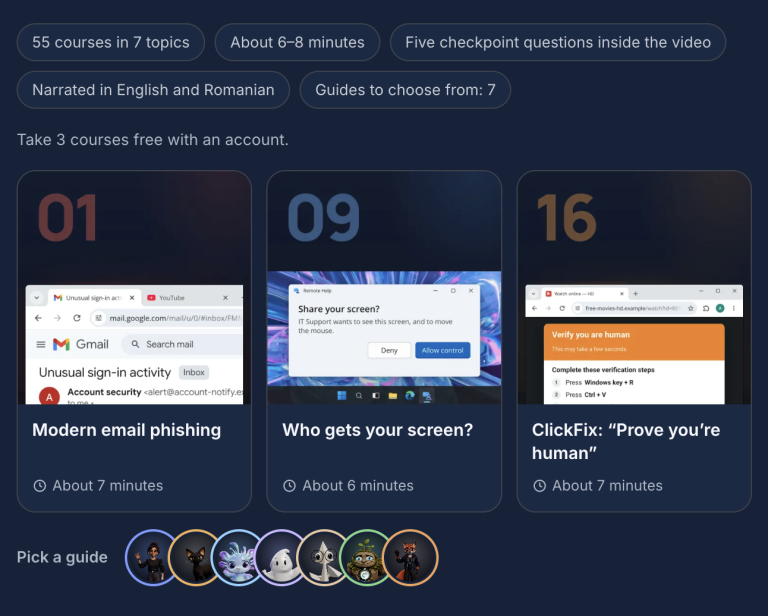
- Learn with a guide. Each video course lasts six to eight minutes, comes with a guide the learner chooses, and stops five times for a question nobody can skip. A lesson rushed through earns no points and does not count towards an assignment.
- Practice in a game-like scenario. The employee steps into a realistic situation, follows the clues, chooses the next move and sees the consequences/impact of their actions.
- See it in CyberSense. The score combines what people know with how they act in scenarios, and it shows each person and each team where to improve and where they are good at.
What content does CyberPlay offer?
CyberPlay offers 55 video courses in seven topics and 17 games that cover phishing, QR phishing, social engineering, ransomware, passwords, backups, physical security, remote work and Wi-Fi.
In Phishing Detective 3D, the player traces how a €47,850 supplier payment request reached Finance. The Social Engineer puts ten or eleven requests in front of the player during one workday, at the badge door, at the desk and on the phone. Ransomware Survival shows a manager how each postponed security task feeds the attack that arrives later. The platform runs in nine languages.
These aren’t imagined scenarios. They’re the kinds of attacks happening to real organizations, every single day.
Why should companies use cybersecurity awareness games?
Companies use gamified cybersecurity awareness scenarios because a decision made in a realistic environment reveals true behaviour, and behaviour is what attackers exploit.
- Training that measures knowledge: checkpoints inside every video and first-attempt scores show what people understood, and certificates record that first score.
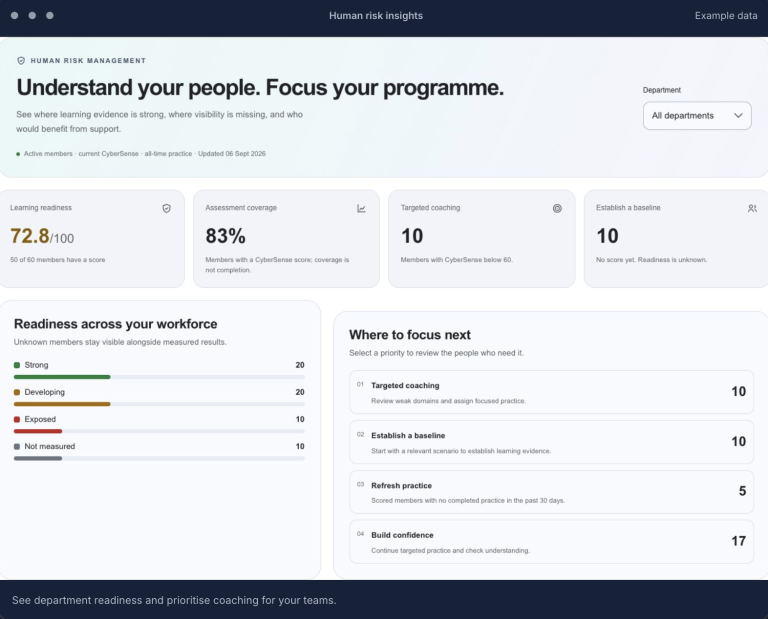
- Coaching priorities by department: Team CyberSense, department readiness and the questions people miss most show where the next session will have the biggest effect.
- Targeted assignments: managers assign a course to everyone, to one department or to chosen people, with a due date and a minimum number of correct answers.
- A programme that fits the company: team campaigns, roles, departments, single sign-on, your own branding and CSV exports for internal reporting.
How does CyberPlay support NIS2 and DORA training?
CyberPlay helps companies deliver and document the staff training that NIS2 and DORA require. Article 21(2)(g) of the NIS2 Directive lists cybersecurity training among the required risk-management measures, and Article 13(6) of DORA makes security awareness training compulsory for all staff of financial entities, senior management included. Assignments, first-attempt scores and certificates give the company a clear record of who trained, when and with what result.
Bring CyberPlay to your team
Watch a free lesson, such as Modern email phishing or ClickFix: “Prove you’re human”, and play a scenario to see the loop for yourself.
Then talk to the CyberPlay team about a programme built around your departments, your branding and your training calendar.
Security awareness pays off when people practise a decision before they meet it at work, and CyberPlay gives companies that practice along with a clear view of the results.