Romania recorded about 13,000 cyber events in Mastercard’s Threat Landscape in Southeast Europe whitepaper, with ransomware leading at 21% and sudden peaks such as in February 2026. At the same time, fraud is getting personal: according to Romania’s National Cyber Security Directorate (DNSC), the number of online frauds nearly doubled in 2025. Threat intelligence has become one of the few tools that help defenders see these attacks coming.
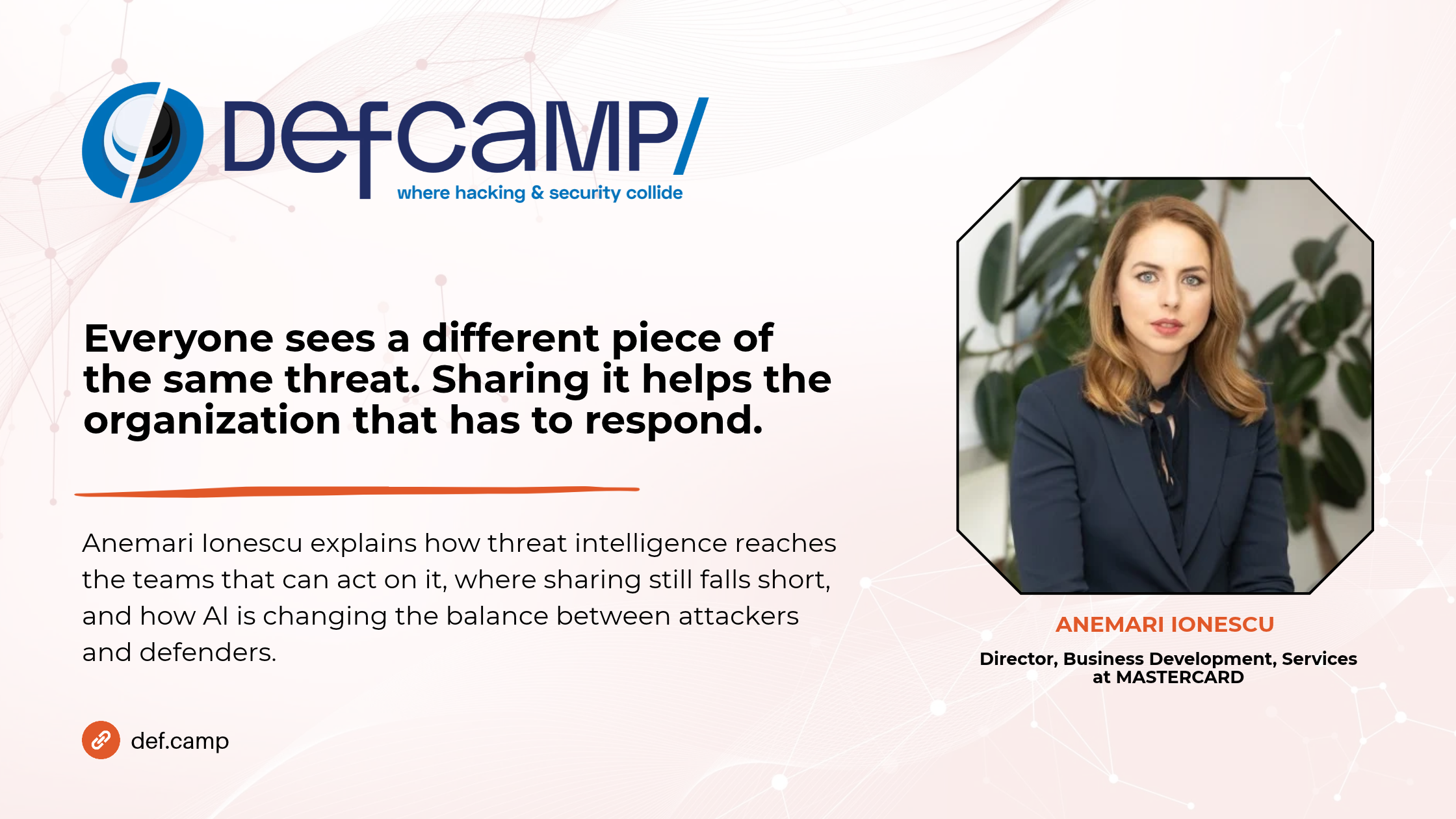
Threat intelligence is information about attackers, their tools, and their targets, analyzed so that an organization can decide what to protect, investigate, or block first. We asked Anemari Ionescu, Director, Business Development, Services at Mastercard, how AI is changing the balance between attackers and defenders, how Recorded Future turns data into decisions, and what Romanian organizations should change first.
We spoke with Anemari just a few days ahead of DefCamp 2026, where Mastercard returned as a partner to hear which threats teams find hardest to assess and where useful information still arrives too late.
AI speeds up attackers, and defenders have to keep pace
In a region with thousands of recorded events and sudden spikes in activity, speed decides who wins. Attackers now use AI to research targets, write convincing messages, and build malware faster than ever. Defenders have access to the same technology, but they also carry something attackers lack, namely, knowledge of their own systems. For Anemari, that inside view is where defenders still hold the advantage.
Attackers use AI to work faster, carry out more attacks, and make their attempts more convincing. They use it to research targets, tailor fraudulent messages, and develop malware.
Security teams can use AI to examine more information and find connections faster. Recorded Future, a Mastercard company, uses it to help investigate alerts, understand adversary intent, and identify vulnerabilities that attackers are already exploiting. Our 2027 State of Threat Intelligence report, based on a global survey of 768 security professionals at large companies, found that 98% of respondents had adopted AI and 96% planned to expand its role in threat intelligence. Their comfort drops as the stakes rise: 70% accept some AI autonomy for drafting reports and summaries, but only 56% for enforcement actions or takedowns.
Defenders can combine external threat intelligence with knowledge of which systems are exposed and evidence of how well their defenses work. At Mastercard, we look at these together. Many organizations are not there yet. Only a quarter of the professionals we surveyed say external intelligence and internal data from their own systems sit on a single platform, and 18% still rely on analysts to connect them manually. A threat may affect a whole sector, but the response depends on the systems and activities each organization relies on. That information needs to reach the team in time to help prevent an incident or limit the damage.Anemari Ionescu, Mastercard Tweet
The full findings are available in Recorded Future’s 2027 State of Threat Intelligence report, based on a survey of security professionals at enterprises with at least 1,000 employees. Its numbers come up again throughout this interview. Together, they show an industry that has embraced AI but is still learning how far to trust it.
How threat intelligence turns data into decisions
Most security teams do not suffer from a lack of data. They collect alerts, feeds, and reports faster than anyone can read them, often from several vendors at once. A money mule is a person or bank account that criminals use to receive and move stolen funds, so that the money is harder to trace. The real challenge, Anemari explains, is turning all that volume into a decision someone can act on in time.
Part of the problem is fragmentation. The companies in our report use five threat intelligence vendors or products on average, and 79% plan to consolidate in the next year, mainly to correlate signals better and bring separate tools together.
Recorded Future analyzes information from more than one million sources, including the open web, dark web, and technical sources. Its Intelligence Graph links that information, while AI helps teams investigate alerts and identify threats relevant to their systems. Insikt Group's research helps explain the activity identified, so teams can decide what needs attention first.
For supplier risk, Third-Party Risk monitors ransomware exposure, dark web activity, and signs of a breach. This can help a team identify a potential supplier compromise before receiving a formal notification.Anemari Ionescu, Mastercard Tweet
“In October, we shared a recent example from Europe. A customer at a private bank had already authorized a €60,000 transfer. Before the payment went through, the bank checked the recipient’s account in real time. Information from Cybera confirmed that the account was linked to a scam, so the bank stopped the transfer.
That same kind of intelligence is now available through Recorded Future, Mastercard’s threat intelligence company. Cybera’s Money Mule Intelligence helps fraud prevention teams identify in real time the bank accounts criminals use to move illicit funds. This gives financial institutions the information they need to intervene before the money reaches those accounts. Fraud teams increasingly work this way: 47% of the organizations we surveyed say their fraud prevention teams now use threat intelligence.”
Closing Romania's resilience gap after NIS2
Romania has moved quickly on regulation, and enforcement of the NIS2 Directive is now live. Mastercard’s whitepaper notes, however, that resilience still lags behind the rules. Cyber resilience is an organization’s ability to contain an incident and keep or quickly restore its essential services. Anemari believes the first fix starts in the boardroom.
Meeting regulatory requirements does not automatically mean an organization can contain an incident and restore its services.
The first priority set out in the whitepaper is to assign executive ownership of cyber risk and define how long critical services can be unavailable and how quickly they need to be restored. This includes reviewing the resources needed to meet those targets. Regular restoration tests, crisis exercises, network segmentation, and assessment of critical suppliers are also priorities.
To assess the defenses already in place, we look at the attacks being used, the systems exposed, and how the existing controls respond. Testing those controls against relevant attack techniques helps establish how well they work. Few organizations check this today. In our survey, 31% of respondents said they measured whether actions triggered by threat intelligence actually worked. Separately, 24% reported that their organization takes those actions autonomously and then checks whether they were effective.Anemari Ionescu, Mastercard Tweet
How impersonation fraud is changing across the region
For years, people learned to spot scams by their mistakes: clumsy wording, strange numbers, unfamiliar voices. Voice cloning, deepfakes, and flawless AI-written messages have erased most of those clues. Fraudsters can now sound like a colleague, a bank employee, or even a member of the family. Anemari explains why these fakes earn our trust so quickly, and what fraud teams look at beyond the message itself.
With AI, fraudsters can make a request sound like it comes from someone you know. They can copy a familiar voice and tailor the message to your relationship with that person. That makes it harder to establish whether the request is genuine.
Fraudsters exploit fear, urgency, and concern for loved ones. A call that uses a child's cloned voice can make a parent believe they need to help immediately. Posing as a bank employee or an official can also make a request seem legitimate and urgent.
For fraud teams, checking the message is only part of the investigation. The websites and systems behind it may reveal links to other attacks. That gives the team additional evidence beyond what the message says or who appears to have sent it. Companies are preparing for this. In our survey, 62% of respondents said their organizations already use brand and impersonation monitoring. For deepfake or narrative intelligence, 41% reported current use, and another 52% said they planned to adopt it.Anemari Ionescu, Mastercard Tweet
United Against Scams and the power of a family password
In March 2026, the Romanian Police, the National Cyber Security Directorate (DNSC), the Romanian Banking Association and Mastercard launched United Against Scams, part of the Siguranța Online initiative. The campaign groups scams into recognizable techniques such as “Urgent Emergency”, “Official Phone Call” and “Overnight Winnings”, and pays special attention to older people. Its most practical advice fits in a single word agreed around the kitchen table. For Anemari, the family password is the simple habit most likely to protect the most people.
The campaign, launched with the Romanian Police, the National Cyber Security Directorate (DNSC) and the Romanian Banking Association, explains how scams work through real examples. People can see how a phone call or message uses fear, urgency, or concern for someone close to them.
We encourage families to agree on a password: a word or detail from a shared memory that only they know. If someone calls claiming to be a relative in trouble, ask for the password. It provides a way to check their identity, even when the voice sounds familiar.
Agreeing on a password also gives families an opportunity to discuss online safety, particularly with more vulnerable relatives. When a frightening call arrives, the family has a check they have already agreed on.Anemari Ionescu, Mastercard Tweet
Where threat intelligence sharing still falls short
Disruption rarely comes from a single direction. Mastercard’s whitepaper points to supplier concentration as one of the biggest risks, where many organizations depend on the same few providers, and one failure can ripple across a whole sector. Banks, telecoms, authorities and vendors each see a different piece of the same threat. Anemari argues that sharing only helps when the right information reaches someone who can act on it, and when that person knows how solid it is.
Companies, security specialists, law enforcement and defense institutions have different information about the same threats. Sharing that information can help the organization that needs to respond. Through the CYBERA partnership, financial institutions receive information about scam-linked accounts. The aim is to make relevant information available to someone who can act on it.
For that exchange to be useful, recipients need to know what has been confirmed, what is an assessment, and what still needs investigation. That helps them understand which decisions the evidence can support. Sharing also falls short inside organizations. In our survey, 85% of respondents said teams outside core security already use threat intelligence. Where those teams use it, only 19% report that tailored intelligence is sent to them automatically, while 36% rely on scheduled reports or briefings, or on channels such as email and chat.
For suppliers, organizations need to know where they depend heavily on the same provider. 51% of the professionals we surveyed already use threat intelligence to identify supply chain and third-party risks. The recommendations also cover incident notification, audit rights, and workable options for changing providers.Anemari Ionescu, Mastercard Tweet
Why Mastercard keeps coming back to DefCamp
Mastercard’s teams work where payments, fraud prevention, and cybersecurity meet. That position means a technical finding is never only technical: it affects the services a company runs and the customers who rely on them. DefCamp brings together people who see the same threats from very different angles. For Anemari, those different perspectives were the reason to return.
At DefCamp, I can discuss security problems with people whose experience is different from ours. We work across payments, fraud prevention, and cybersecurity, so we need to understand what a technical finding means for the services a company runs and the customers who use them.
We keep returning to hear how other teams handle these problems and discuss where we can help. I would like to understand which threats they find hardest to assess, where useful information arrives too late, and what evidence would help them decide what to do next.Anemari Ionescu, Mastercard Tweet
Every threat intelligence team works with a gap between what it knows and what it needs to decide. Tools narrow that gap, but conversations with people who see the same attacks from another seat often close it. What did Anemari want to take back from those conversations at DefCamp?
I came to DefCamp to talk with teams about how threat intelligence helps in situations they deal with: a supplier showing signs of compromise, a domain impersonating a brand, or a payment to a scam-linked account. The information can help the team decide what to investigate and where to intervene.
AI is now part of almost every threat intelligence team's work, but trust has not kept pace. In our survey, the most common reason for not giving AI more autonomy was lack of auditability and explainability, cited by 39%. The people who use the results still need to know where they came from and what they support.Anemari Ionescu, Mastercard Tweet
Stay connected with the DefCamp community
DefCamp 2026 brought almost 2,800 professionals from 700 organizations to the Palace of the Parliament in Bucharest on November 19 and 20. Over two days of talks, workshops, and competitions, teams like Mastercard’s compared notes with the people who face the same threats every day.
Follow DefCamp for highlights from this year’s edition and the first news about the next one.
Meet the interview author:

Nadine Tudor is a marketing and communications trainee at Bit Sentinel, where she especially enjoys creating social media content and visual assets. New to cybersecurity, she’s eager to keep learning and to help make complex security topics easier for everyone to understand.