


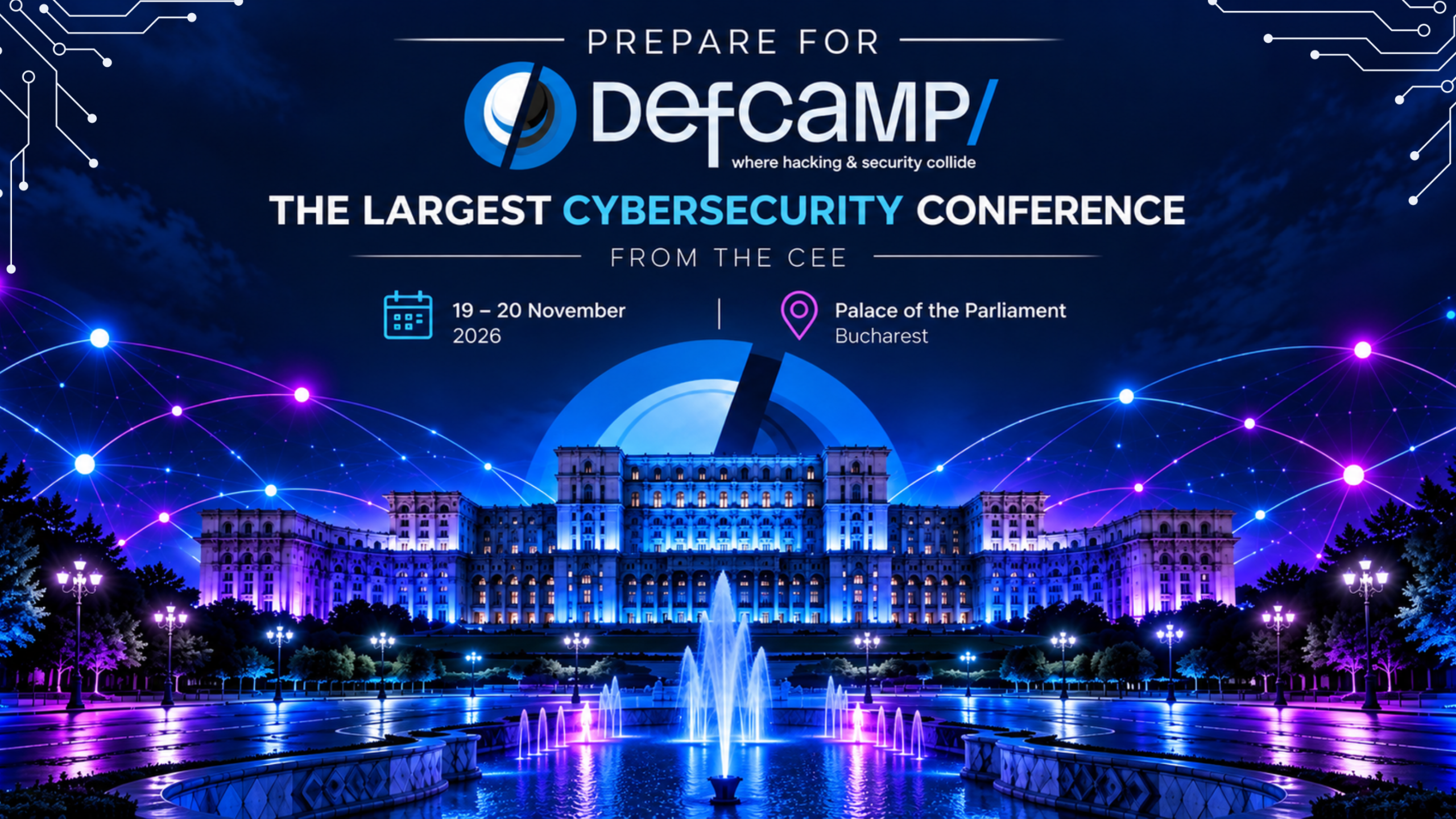
DefCamp 2026: 16th edition brings over 2,500 cybersecurity professionals to the Palace of Parliament
DefCamp 2026, the largest cybersecurity conference in Central and Eastern Europe, takes place November 19-20, 2026, at the Palace of the Parliament in Bucharest. The 16th edition will bring together more than 2,500 specialists, business leaders, and decision-makers from 700 public and private organizations, with over 100 international speakers across four stages and more than 10 hands-on competitions.
Let’s review the facts:
Dates: November 19–20, 2026
Location: Palace of the Parliament, Bucharest
Edition: 16th
Attendees: 2,500+ professionals
Organizations represented: 700
Speakers: 100+ local and international
Stages: 4 (3 technical, 1 executive debates)
Competitions: 15+ in Hacking Village with a prize pool of €35,000+
Why Is Cybersecurity a Boardroom Priority in 2026?
Cybersecurity has moved from the server room to the boardroom because a single incident can now halt an entire operational chain, not just infrastructure. Budgets are approved at the executive level, and organizations in Romania and the wider region face a growing threat landscape: ransomware, supply-chain attacks, and operations run by criminal groups or state actors.
Artificial intelligence is accelerating this shift. AI lowers the cost and technical barrier for attackers, increasing both the speed and scale of attacks. At the same time, European regulations – NIS2, DORA, and the Cyber Resilience Act (CRA) – are pushing accountability for cyber resilience directly onto executive leadership through stricter governance, risk management, and reporting requirements.
What’s on the DefCamp 2026 Agenda?
DefCamp 2026 runs across four stages – three technical, one dedicated to executive debates – with sessions spanning application security, cloud, OSINT, industrial systems, hardware, offensive AI, governance, and new EU regulations.
Confirmed technical sessions include:
- Johnny Xmas – “5 Lies Enterprise Security Still Tells Itself” – examines recurring mistakes large companies make, from outdated risk registers to expensive, uncalibrated security tools.
- Robert Kruczek and Kamil Szczurowski (Poland) – “Hacking the Government 101” – exposes vulnerabilities found in Polish government web infrastructure, officially reported to CSIRT GOV, NASK, and the Ministry of Defense.
- Davis Zheng and Donavan Cheah – “False Signals: Emulating Space Systems for Threat Intelligence” – shows how decoy systems mimicking satellite infrastructure help identify threat actors.
Executive debate topics include realistic AI investment evaluation, crisis communication, turning EU compliance requirements into competitive advantage, and cyber education in the region.
New speakers and topics will be announced as the program is finalized.
What Happens in the Hacking Village?
Hacking Village is DefCamp’s practical cybersecurity lab, running for the full two days with more than 15 competitions and challenges across IoT, electronics, cloud, OSINT, and wireless security.
One example: participants use hardware equipment to intercept, decode, and analyze radio communications between drones (or other IoT devices) and their control stations – turning conference-stage research into hands-on practice. Competitors can win a combined €35,000+ in prizes.
The Hacking Village infrastructure is powered by the CyberEDU technical platform.
Organizers and partners
DefCamp 2026 is organized by Cyber Security Research Center from Romania (CCSIR), powered by Orange Business. The conference is supported by Mastercard as Platinum partner, Syncnode and Bit Sentinel as Gold partners, and Booking Holdings, Adobe, IGEL and StealthMole as Silver partners.